
The Truth About Performance, Work-Hardening, and the Future of Titanium Axes
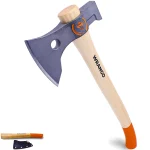
For decades, the knife and axe world has obsessed over one metric above all others: Rockwell hardness. Ask almost any steel blade enthusiast what makes a “good” blade, and the first thing they’ll ask is, “What’s the HRC?” Somewhere along the way, the idea took root that a higher Rockwell number automatically means a better cutting tool.
But titanium changes the conversation entirely.
At Wrango Tools, we’ve spent years exploring the limits of titanium in hard-use tools, especially with our titanium tomahawk axes. What we’ve learned is simple: when it comes to titanium axe blades, Rockwell hardness is one of the least important numbers you can focus on.
That might sound controversial in a market trained to compare steels based on hardness charts and heat treatment claims, but titanium doesn’t behave like steel — and trying to judge it by steel standards completely misses the point.
The reality is that titanium alloys operate on an entirely different set of mechanical principles. Their performance comes not from extreme hardness, but from strength, flexibility, impact resistance, crystalline structure, and a unique phenomenon called work-hardening.
And that’s exactly why titanium tomahawks are unlike anything else on the market.
Titanium Is Not Steel
Steel blades are typically hardened through quenching and tempering. Increase hardness too much and the blade becomes brittle. Lower the hardness and the edge may roll or deform. Blade makers spend decades balancing this tradeoff.
Titanium doesn’t play by those rules.
As titanium bladesmith Mecha explained in a detailed discussion about titanium axes, titanium alloys are not normally engineered around hardness at all. In aerospace and industrial applications, titanium properties are controlled primarily through alloy composition and precipitation hardening rather than traditional quench-hardening methods used in steel.
In fact, Rockwell testing on titanium can vary dramatically even on the same sample. According to Mecha, a titanium sample can fluctuate by several HRC points during testing, making Rockwell hardness an unreliable metric for evaluating real-world performance.
That’s because titanium’s cutting performance is not determined by hardness alone. Instead, it’s determined by how the alloy responds to impact, stress, deformation, and repeated use over time.
Titanium Axes Gets Better With Use
One of the most fascinating aspects of titanium tomahawks is that they actually improve the more they’re used.
This effect is known as work-hardening.
Unlike steel, which generally wears down gradually from repeated impacts, titanium alloys — especially alpha-beta alloys like Grade 5 titanium — respond to repeated stress by becoming stronger and more stable. Mecha described this process almost like “seasoning” a blade.
The more a titanium axe is used, the more the crystalline matrix adapts to impact loading. Over time, the edge becomes more resistant to deformation, galling, and wear. According to Mecha, by the third sharpening users may already notice the difference, with the blade holding performance significantly longer than when it was brand new.
That’s almost unheard of in traditional steel tools.
Most steel axes slowly degrade with use unless they are constantly maintained. Titanium behaves differently. Repeated impacts actually help stabilize the edge structure and improve long-term performance.
In other words, your titanium tomahawk doesn’t “wear out” the way people expect. It evolves.
Why Flexibility Matters More Than Hardness with a Titanium Axe
Axe blades are impact tools first and cutting tools second.
That distinction matters.
An axe experiences forces that are dramatically different from a knife. Every swing creates shock loads that travel through the edge, eye, poll, and handle. A steel optimized purely for hardness may hold an edge well on paper but chip, crack, or fail catastrophically under repeated impacts.
Titanium excels because it combines strength with flexibility.
A titanium tomahawk can absorb enormous shock without becoming brittle. Instead of snapping or cracking under abuse, the alloy flexes and redistributes force. That flexibility dramatically improves survivability in real-world use.
Mecha explained that the goal in advanced titanium heat treatment is not simply to achieve a high hardness number, but to create a stable structure that resists rolling, galling, deformation, and edge collapse.
In extreme conditions, titanium is actually more likely to chip slightly than bend permanently — a trait that many hard-use users prefer because it preserves overall geometry and structural integrity.
That’s a completely different philosophy from chasing maximum Rockwell hardness.
The Misunderstood Nature of Titanium Axe Edges
One of the biggest misconceptions about titanium is that people expect it to behave exactly like steel.
It doesn’t.
Titanium edges are not designed for ultra-high abrasion resistance like some premium super steels. Instead, titanium thrives in applications where durability, toughness, corrosion resistance, lightweight handling, and impact survivability matter most.
That makes titanium especially effective for tomahawks, survival axes, breaching tools, camp tools, and tactical applications.
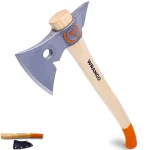
Our Wrango Tools titanium tomahawks are engineered around these principles. We work with specialized titanium manufacturing processes designed specifically for high-impact use rather than chasing arbitrary hardness numbers for marketing purposes.
Because at the end of the day, an axe isn’t judged by a laboratory test.
It’s judged by how it performs after years of hard swings, harsh environments, and real-world abuse.
Titanium Axes Are the Future of Hard-Use Axes
Titanium remains one of the most underrated materials in the blade world.
Part of that comes from people applying steel logic to titanium tools. Another part comes from the fact that truly optimizing titanium is extremely difficult. Advanced titanium hardening techniques are complex, expensive, and far less common than traditional steel heat treatment.
But when done correctly, the results are remarkable.
Titanium tomahawks offer:
- Exceptional corrosion resistance
- Extreme strength-to-weight ratio
- Outstanding shock absorption
- Long-term work-hardening performance
- Reduced fatigue during carry and use
- Incredible durability under impact
And unlike many steel tools, titanium simply refuses to rust away over time.
For users who demand lightweight performance without sacrificing durability, titanium isn’t a gimmick — it’s an evolution.
Final Thoughts – Titanium Axe
The obsession with Rockwell hardness has caused many people to overlook what actually matters in an axe.
Axes are dynamic tools subjected to violent impact forces, not static edge-retention experiments. Titanium succeeds not because it achieves extreme hardness numbers, but because it balances strength, toughness, flexibility, and structural stability in ways steel simply cannot.
The more you use a titanium tomahawk, the better it becomes. The alloy adapts, hardens through use, and develops a level of resilience that conventional steel tools struggle to match.
At Wrango Tools, we believe the future of hard-use axes isn’t about chasing higher HRC numbers.
It’s about building tools that survive, evolve, and perform when it matters most.
And that’s exactly what titanium was born to do.