
Titanium edge retention is often debated when comparing titanium and steel axes. While titanium has a lower Rockwell Hardness, edge retention also depends on factors like yield strength. Titanium’s ductility means it can deform before breaking, though such extreme conditions are uncommon and highly unlikely when chopping wood. Here’s why:
Rockwell Hardness, Yield Strength, Janka Hardness, and Tensile Strength
Lets review material properties first.
The Rockwell Hardness test determines the hardness of metals by measuring the depth of indentation produced by a standardized indenter, usually a diamond cone or hardened steel ball (brale), under specific load conditions. This method quantifies resistance to indentation under controlled testing parameters.
Yield Strength refers to the maximum stress a material can endure before experiencing permanent deformation. For reference, steels used in axes typically exhibit yield strengths around 60,000 PSI, whereas titanium can achieve 120,000 PSI or higher.
Wood hardness is assessed via the Janka scale, which measures resistance to denting and wear by pressing a steel ball into the wood. Although the Janka scale cannot be directly correlated with Rockwell hardness, comparative studies—such as those conducted by Nydress® Flooring—suggest that maple, one of the hardest common hardwoods in the USA, rated at 1450 Janka, corresponds approximately to a Rockwell hardness of 23 HRC. (Source): https://d1lwbc8g03kxk2.cloudfront.net/technical-resources/RockwellJankaHardnessRev10.pdf

Tensile strength denotes the maximum stress a material can sustain before failure. Both steel and titanium offer comparable tensile strengths, though these values can vary widely depending on the specific alloy or grade employed.
Material Toughness is the ability of a material to absorb energy and plastically deform without fracturing. Steel generally offers better toughness but often breaks while titanium will deform before it breaks. However, at 120,000 PSI, you need an amazing amount of stress to deform the titanium. Cutting and chopping wood does not approach this threshold.
Axe Blade Sharpness
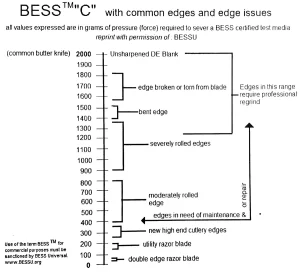
According to the Bess Sharpness Scale, a butter knife requires 2000g of force to cut a poly test string, while razor blades measure between 100g-200g. High-quality pocket knives generally register below 200g. Axe blade sharpness typically ranges from 350g to 1200g, with most tested axes falling closer to 1000g; a particularly sharp axe should be under 600g. Axe edges differ substantially from knife blades, as they are not designed to be as thin and sharp, contributing to increased durability and reduced wear, especially with materials such as titanium.
Titanium Edge Retention Summary
With an axe, you’re striking a material (wood) that is much softer than titanium, in the range of 18-23 HRC vs. titanium at 40-44 HRC. Titanium also has extremely high yield strength, so it takes an extremely high impact or stress to deform it permanently. While it’s possible under extreme conditions for softer materials like wood to deform harder materials like titanium, it’s extremely unlikely, especially given the high yield strength and tensile strength of titanium.
Check out this video we did comparing a steel axe blade vs. our titanium axe blade: https://www.youtube.com/shorts/2dNTdmGHdjw
Bonus… Can You Sharpen Titanium?
Yes, you can sharpen titanium with a standard sharpening stone. Remember what we just learned…Titanium is softer than steel and softer than a sharpening stone made to sharpen steel blades. A standard sharpening stone made to sharpen steel will easily and quickly sharpen titanium as well. Pick them up online for $10-$20.